Wednesday, March 26, 2014

Thailand

ANCIENT KINGDOMS OF ASIA, THAILAND
November 3-6 and 20-21, 2013
Chapter I

Catherine and Peter have long anticipated exploring Thailand, Laos, Cambodia and Vietnam. The attractions for us were to learn more, and at first hand, about the ancient and more recent histories of these countries. We enjoy Asian food. This Overseas Adventure Travel (OAT) tour included all four countries, each country with their own local guides. The trip dates coincided well with our plans for an Appalachian Trail Hike, a Davidson Family Reunion and visits with our friends, Nora and Ken in Oregon and Susan in California. The timing was fortuitous!

We have decided to present each country separately.  Chapter II Laos, Chapter III Vietnam, and Chapter IV Cambodia will follow.

Day 1 November 3, 2013
We flew with Cathay Pacific Airways from Los Angeles to Hong Kong to Bangkok. It was economy class (tightly packed passengers), but the service could not have been better. There were multiple meals and my wine glass was filled as often as I desired. I caught up on movies I had missed in the past five years. Whether due to uncomfortable seat or excitement about the trip, I did not sleep much. Peter evidently had no problem with the seats, just installed his ear plugs and eye covers, and awoke pretty much only to eat. We “lost” a day crossing the International Date Line, but we knew that “Going West is Best” for jet lag. We experienced no jet lag.

We could not escape noticing many Thai expressions from signs to photos of the King, and lovely orchids.


THAILAND with PE

We were met upon arrival in Bangkok by Kapeeporn Dhammasidhi, “Call me Pe”, who was our trip leader for the entire trip. She is a petite, patient, competent, vivacious celestial dancer, and all-together fun lady. Thank you, Pe!

We visited the Day and Night Markets by tuk-tuk.  Pushcart vendors and street stalls offered a variety of Buddha statues, clothing, jewelry, art, and other souvenirs. There were attractive displays of fresh herbs and ground seasonings that create the backbone for Thai kaeng (curries), which are thinned with coconut milk, decorated with vegetables/meat and served on  rice.

We learned much about Thailand during our brief stay there. Here are some highlights.

Thais greet one another with a prayer-like gesture of the palms and a bow of the head (more bow to greet a monk, senior or superior) and saying, written phonetically, “sa-wat-dii kha” (if speaker is female) or “sa-wat-dii khrap” (if male). Goodbye is “laa kawn”, and thank you is “khawp khun”. We did not progress much beyond this in spite of Pe's continuing efforts. Just to make it more challenging, words with the same spelling can have different meanings depending on changes in pitch. It takes a practiced ear to distinguish the differences of the five different tones.


We attempted learning about Thai “religion”. Theravada Buddhism is predominant. Buddha was a prince who left a life of privilege at the age of 29 in the 6th Century, BC. His quest to find the truth and his meditation were rewarded with his emancipation, breaking the cycle of birth, death and rebirth. He became The Buddha, or enlightened one, to teach the “middle way”. Constant patience, detachment, and renouncing desire for worldly pleasures brings peace and liberation from suffering. Passion, desire, love, and hate are regarded as extremes. We would like to know more.


 There is much Chinese and Hindu influence.  One of my favourite Hindu dieties, beloved by many is Ganesha, with his 2-16 arms, large belly and the head of an elephant with a broken tusk.  A fascinating story describes how this came to be. He is the patron of arts, sciences and letters.


Thai males often become monks for at least short periods of their lives. In other words, they can be monks without a long-term commitment. Monks are respected highly in all the countries that we visited. Their “blessings” are sought by lay persons, who give “alms” in the form of food. We understand that monks do not use or carry money. They live communally on temple grounds.


Temples and temple grounds are open to members of the public, who are expected to show respect. Head wear and shoes are removed before entering temples. Men and Women are expected to cover shoulders, and pants or skirts must extend below the knees. In fact, there are monitors who restrict entry into their sacred places to those improperly dressed. Alternatively, if judged to not be dressed suitably and still wanting entry, one may purchase on the spot, a garment to cover the offending skin.

Thais build spirit houses (“phra phuum”) outside buildings and homes to encourage spirits to live nearby and in comfort, to bring good fortune to the site. They are ornate wat-like structures set on a pedestal in a prominent section of the yard. Food, drink and money are offered to the spirits to smooth daily life. Our hotel had a spirit house at the front entrance and offerings were freshened each day.

Thai food is a complex balance of spice, salt, sweet and sour. The ingredients are fresh and light with lots of lemon grass, basil, coriander and mint. Pungent “naam plaa” (fish sauce made from anchovies) added with zest of lime, a pinch of sugar, minced garlic and ginger for vegetables, chicken, beef, pork, tofu or fish mixed with coconut milk to make a curry.


We favoured several dishes. There were “yam plaa meuk” (spicy squid salad with mint leaves, cilantro and Chinese celery), whole fried tilapia, lotus leaves with garlic, sticky rice around banana, bean paste wrapped in a banana leaf or in bamboo, “tom yam kumg” (coconut soup with prawns) and “tom khaa kai” (coconut soup with chicken and galangal), and catfish. For us, the best dishes were vegetarian; not philosophically, but just because they tasted better. Seafood was tender and tasteful, but beef, chicken and pork were not worth chewing...and chewing...and chewing.


The Thai elephant is it's most revered indigenous mammal, symbolizing wisdom, strength and good fortune. The shape of Thailand has been likened to the head of an elephant.


The Asian elephant is now endangered, having lost it's traditional role in society and much of it's habitat. Like all countries with a high population density striving for economic advancement, the forest cover has declined dramatically. Legislation is coming into effect to address environmental issues, but many citizens are marginalized in their ability to feed their families and corruption impedes the government's attempts to shelter species coveted by illicit global wildlife trade. Please don't buy endangered or exotic animals as pets.

Instead, you should consider, the popular and comfortable Thai pants modeled by our OAT group.


Day 2 November 4, 2013
Our accommodations at the Pantip Suites were spacious! There was an entrance foyer with closets, kitchen/dining area, living room, bedroom, bath with connected dressing room and a Balcony overlooking Bangkok from the 19th floor. We could have entertained 4 more comfortably in our suite. The refrigerator was stocked with the local beer, Singha. Even though by now it was 2 AM local, I couldn't resist the large bathtub! Peter brought me a “cold Singha” in the tub. Heavenly!


Day 3 November 5, 2013
Up again early for the start of our Asian adventure! There was a daily breakfast buffet that, in it's diversity, could satisfy any palate. Obviously, in this western style hotel we were not eating like the “man-on-the-street”, but we did follow Bangkok custom of having noodle soup for breakfast.


It was prepared on the spot by dipping a strainer basket of rice noodles into boiling water, then adding vegetables, fish, beef, or chicken, chopped egg, tiny shrimp and spices (dried red chilli, sugar, fish sauce and vinegar). The soup was accompanied with pickled duck egg and followed by an assortment of lovely fruits, some new to us (mangosteen and various kinds of dragon fruit). Of course, there was a diversity of rice-based dishes. To cater to western tastes, there were chefs making omelets and waffles to order, and warming trays with bacon, sausage, and sauteed vegetables. There was a salad bar. There was a bread and cheese table. All this offered for breakfast!

After this sumptuous breakfast we waddled off to meet the members of the group. We introduced ourselves and gave a little background. Most travelers were from the Boston area except for a couple from Long Island, a man from the VA-DC area, and Peter and I. One of our group was from Thailand. He was instrumental in preparing the Boston contingent under the auspices of OLLI (Osher Lifelong Learning Institute), University of Massachusetts, Boston.


We enjoyed a bus tour of the city and ended on the Mekong for a delightful lunch. Once again our OAT group experienced "noodle soup" to order.


After lunch some of us visited the Jim Thompson House and Museum. We were taught how to ride the elevated metro system by our very own native Thai, Wichian. It is very similar to mass transits in many large metropolitan cities, but the trick was for us to figure how much we needed for destination, get our ticket and to stick together “like sticky rice”.


Jim Thompson House and Museum
Jim Thompson was an architect in the US prior to World War II. He joined the Army and was stationed in Europe and Asia. He fell in love with Thailand and after leaving the service, returned there to live.

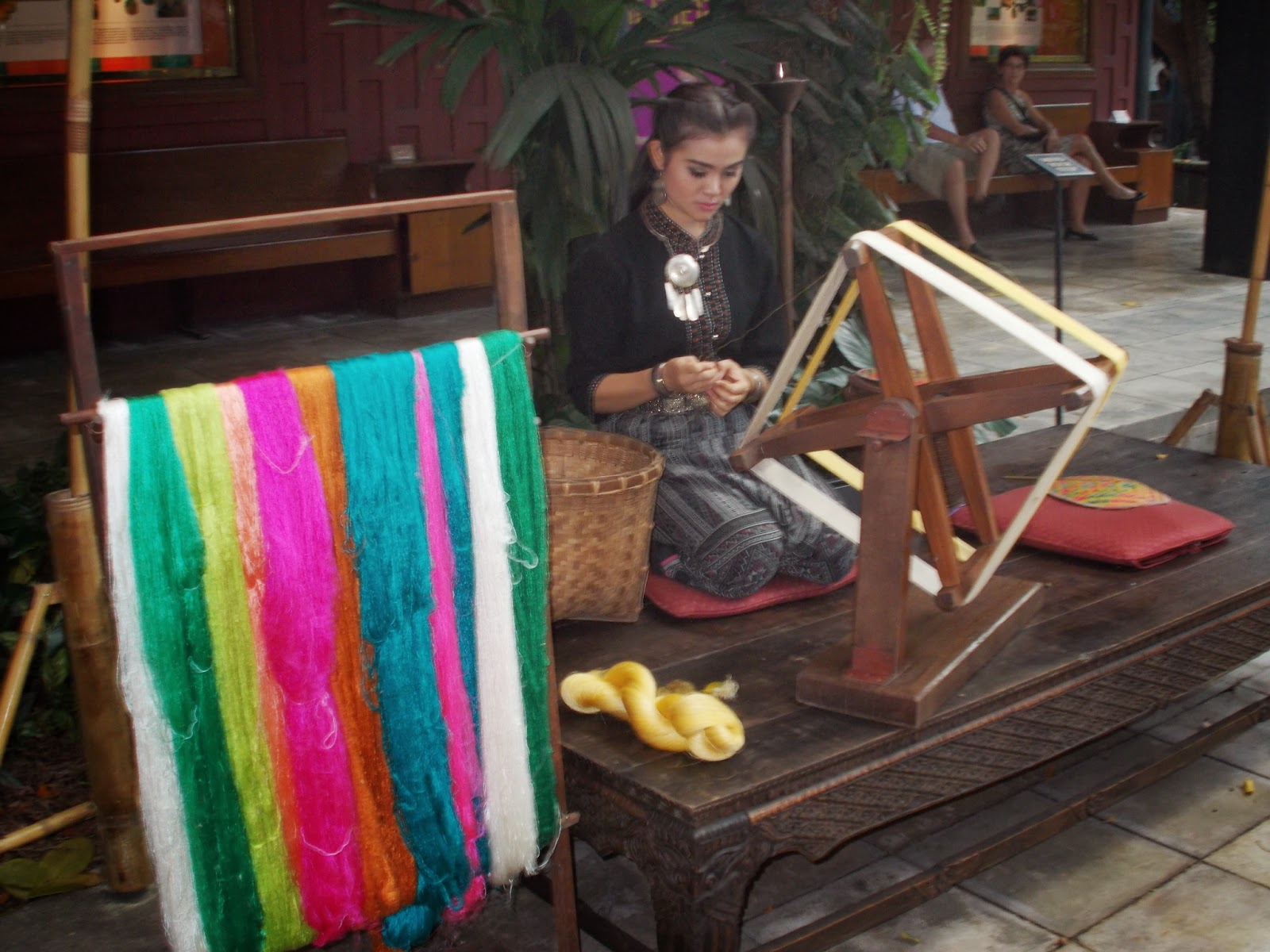
The hand weaving of silk captured Jim Thompson's attention. He became a gifted designer and textile colorist, bringing world-wide recognition to Thai silk. His home reflects many features of traditional Thai architecture; single buildings built of teak, elevated a a full story above the ground to protect from flooding during the rainy season. The roofs are steeply pitched and decorated with motifs related to naga, the mythical sea serpent long believed to be a protector of the home. There are representations mythical birds (garuda) decorating the gables.


We saw silk cocoons being heated, spun then wound on a lazy “Kate”.


They also pleased us with classic Thai dancing in beautiful traditional dress.


We were saved from spending a lot of money on silk goods in their shop by the arrival of the departure time for the next leg of our tour.


Day 4 November 6, 2013
After breakfast, we boarded our bus to Ayutthaya. Three rivers (Mae Nam Lopburi, Chao Phraya and Pa Sak) form the island of Ayutthaya, the Thai capital until two years of war with the Burmese. The city's architectural and religious treasures were taken and the royal family forced to Thonburi, near Bangkok.

Many religious practices might be seen as superstitious.  None-the-less, we all followed the practices.  We learned about shaking a cylinder with "pickup sticks" that fall out with numbers on them and collecting your "future".  Others write their request on a slip of paper with hopes from Buddha.  Collection boxes are used but food donations are also quite acceptable.


Temples were well attended by locals and tourists alike with great respect.


We rode a “Long Tail Boat” on the Mekong River.


Not surprisingly, Peter was attracted to these boats. He inquired about the make of engines. The reply was translated as “wreck”. In other words, the engines came from wrecked road vehicles, when, decades ago, the drive shaft of the engine went straight back from the transmission (no such things as trans-axles then). So, to adapt these to boat use, “wreck” engines were mounted on pivots, drive shaft was extended aft about 5 metres to the propeller. The entire engine, drive shaft and propeller are rotated horizontally to steer, and all tilted up in the most shallow waters. Amazing to Peter!

Then we visited the King's Summer Palace, complete with a topiary of the national elephant, ponds, gazebos and buildings to house the concubines.  Gifts from Japan and elsewhere were readily apparent in splendor.  


A real treat was to meet the Fruit Bar Hostess who provided samples of mangosteen!


Thai pineapple should be entered in the Guinness Book of World Records.


Delicious!

Along the shore of the Mekong River, citizens of all socio-economic classes live. Within a sparse few kilometers, we passed temples, fish farms, luxury hotels, universities, schools, and shanties holding bravely to the water's edge.


Ayutthaya and Ancient Siam, are UNESCO World Heritage Sites and the home to 33 kingly dynasties from as early as 1357. Ayatthuya was the capital of Siam from 1353 to 1767, when it was a place of great wealth.


We continued to Wat Pho, which is the oldest and largest temple in Bangkok and home of the country's largest reclining Buddha made of plaster and finished in gold leaf. This was an amazing place spread out over many acres, and very much visited. The temples are in various states of disrepair with monks strolling meditatively.


Cuu Trung Dai Temple of Thailand and the Old Kingdom of Siam, is full of ceremonial halls. The Old Kingdom of Siam was seen at the Grand Palace of Thailand, Bangkok's defining landmark since 1782, King Mongkut (or Rama IV) first ruled from this palace and was romanticized in the movie “The King and I”. The palace is used now for ceremonial events only. It was beautiful in all it's splendor.

Wat Phra Kaew The Royal Monastery of the Emerald Buddha
The Emerald Buddha was carved from a block of green jade and re-discovered in 1434 in a stupa in Chiang Rai. The jade was covered with plaster, however, an abbot noticed a sparkle of jade where plaster had flaked off the nose. Wars and marriages have caused this Buddha to do quite a lot of traveling, but the original now resides in Thailand. Laos has a temple with a copy.
The Buddha is clad in one of the three seasonal costumes (summer, rainy season and winter).
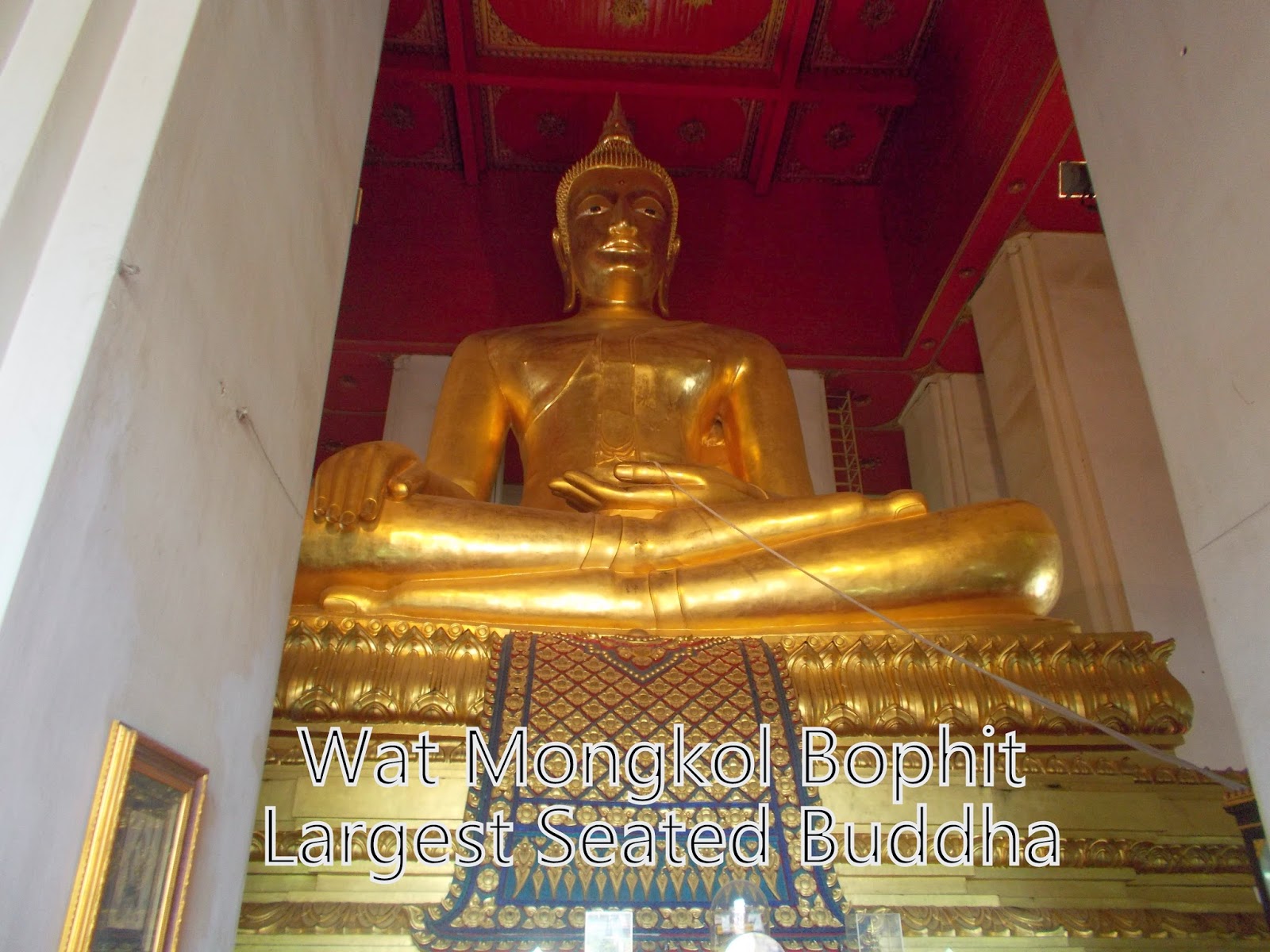
Wat Yai Chaimongkol is a temple flanked by a row of saffron-draped Buddha statues. Wat Mongkol Bophit houses the largest seated bronze Buddha statue in Thailand. Wat Phra Sri Sanphet is where monks live and study.


We visited the elephant camp and enjoyed a ride sitting in the “houdah” while the driver sits behind the elephant's ears. We placed our tip into the elephant's trunk to be passed to the driver sitting on his neck.


Several of our group attended pub crawl in the red light district that evening, where one can meet the “lady boys”, and dance the pole with great enjoyment.

Peter and Catherine were exhausted from this already long day and unfortunately missed this unique event.


RETURN TO THAILAND

Day 18, November 20, 2013
After visiting Laos, Cambodia and Vietnam, we flew back to Bangkok and returned to the Pantip Suite and our Farewell Dinner Cruisie.


The dinner was delightful and afterwards “Our Pe”, true to her habit of surprising us, and wearing a beautiful Thai skirt, entertained us with her Celestial Dancing, which she also attempted to teach us. We danced around the tables up and down the Mekong River.


This journal would be incomplete without mentioning Loi Krathong, which is held on the proper full-moon night, when tiny votive lotus flowers with lit candles are floated on the Mekong from our Dinner Boat.


We each made a wish or said a prayer and one by one our lit candle is lowered in a basket to the river. Lovely watching the parade of lit flowers flowing downstream from our boat.


We shared goodbye hugs and promised to meet again in another fascinating part of the world.

Day 19, November 21, 2013
This was our day to return to North America. We took Cathay Pacific Airways from Bangkok to Hong Kong, and from there to Los Angeles while others of our group continued their overseas adventure travel going in many different directions.

My thanks to Pe, Wichian and Pam for sharing their wonderful photo memories with us.

What a wonderful trip! We are planning a Reunion in Boston April 13th with some of the friends we made on our adventure.

Our visit to Laos will soon be in the next edition of our Rejuvenation Blog. We hope you will find these travels as interesting to read about as we did to experience.  And remember your tiger balm!


We hope you enjoyed this post, Catherine and Peter.

Thursday, January 30, 2014

Davidson Family Reunion

Davidson Rosedale Family Reunion in Salisbury and Charlotte, North Carolina
“Four things come not back:
The sped arrow, the spoken word,
Time past, and neglected opportunity.”
Arabian Proverb
After years of thinking about a Davidson Reunion, we finally found the “critical mass” of interested family to start the planning for the event. It was scheduled for October 19 and 20, 2013.

A BIG thanks to everyone, your presence helped to make it the success that it was.

The following is a link to the reunion slideshow hopefully with music from days gone by:
https://picasaweb.google.com/lh/sredir?uname=116522393952536603607&target=ALBUM&id=5972112840067636305&authkey=Gv1sRgCL2UIZmllKpm&feat=email
The organization of this event was a shared effort. Here are some of the key people that were involved in the planning and execution:
Roberta, Deborah and Catherine – they conceived the idea.
Helen Fisher Jacobs – reluctant but wonderfully helpful contacting family, providing flowers & birthday cake, receiving and organizing fund raiser supplies, .
Helen Louise Kikker and Therese Young – jumped on the organizing bandwagon.
Deborah - provided cemetery flowers, doing headstone etchings, welcoming family.
Michael Zarzecki – printed T-shirts and mugs for fund raising.
Peter Zarzecki – chauffeur for the 2 days and all round support for the reunion.
Roberta – for her super organization, communicating with churches, cemeteries, hotels, restaurants; sharing her research, keeping the budget, registration and attendance info, and providing the genealogy for the quilts for our fund raiser.
Thanks are also due to all who contributed photos and historical displays.

The Davidson Rosedale Reunion was a wonderful meeting of family, many who had never met one another, family who had not seen one another in years, and family who wondered what a family reunion was like. We know that there were family members who would have liked to attend and we're sorry that they could not. My cousin on my Gallagher side has offered his version of what might happen at a reunion. For many of you, it might have been a first. There certainly won't be others quite like it. There were great efforts made to keep all the expenses to an absolute minimum.

Our sincere apologies if we didn't get to visit all the cemeteries we might have or all the headstones in our effort to keep to a schedule. I think that our ancestors would have been proud of this first reunion, none-the-less.
What Happens at a Reunion (Bobby Huddock 2004)
We talk, we sing; Maybe we dance; Maybe we drink; We reminisce; We find out things we didn't know; We ask questions; We eat (sometimes too much); We renew old acquaintances; We enjoy ourselves with old and new relatives; and We make plans to stay closer in the future!
The David and Mabel Young Family were well represented. We were pleased to see David, David and Kathleen, Therese, Margaret and Roger, and Jessica. The Katharine and Joseph Gallagher Family were represented with Katharine, Catherine and Peter, Joseph and Beverly, Patricia and Jenny. The Anne & Bobby Hartley Family was represented by Anne, and Deborah and Brad did an outstanding job of encouraging their family to attend, John and his wife, Michelle and children, and Jonathan and his 3 children were so welcomed. Mary Anne, Cheri and Keri and Brent attended. Helen Louise, Jennifer and Stella were present with Paul. Roberta and Deborah came and stayed after the reunion to learn more about the Davidson Family. We were pleased that Jessica Swanko Dupree was able to join us for the Rosedale tour.

Sadly Connie Young Sorbelli, Caren and Alana and Anita Hartley were not able to attend at the last minute because of medical reasons. Many attendees traveled some distances at great expense and effort.

T


hank you all for the effort you made to attend. Your presence was appreciated by us all.

My interest in family history started when I was young. As a child I was taken “all over” to meet cousins “everywhere”. To my everlasting gratitude, my Grandmother, Charlotte Davidson Young Smith made sure I knew who my relations were. Not only did I get to know my Salisbury and Lake City Family, but she also introduced me to Cousin Sally Southerland, of Charlotte. Sally was interested in genealogy and Scottish Highland Festivals held annually at Grandfather Mountain, NC.


Helen Fisher and I began working on our family tree before computer programs such as Ancestry.com came on the scene. But thanks to that program, I met Roberta and Deborah Gormley. They were stumped trying to figure what the “D” in their Dad's name meant. We are now adding records and photos to Ancestry.com, to make our history part of the public record so that future generations will have access. I think I can say for the Davidson Family, that we are pleased to get to know the Gormleys.

The earliest records we have at this time, are from 1717, when John Davidson and Mary (perhaps Morrison) came from Learne, Ireland. We are fairly certain there is some Scottish ancestry in there somewhere as many Scots came by way of Ireland . We are still trying to solve that puzzle. That is what genealogical research is all about.

We are pleased to share the results of our research in the form of the attached pdf files. When you examine these files you will know as much as we do. There is an old saying, “The best things you can give your children are Roots and Wings”.

Enjoy the photos from the past.  
Catherine Gallagher


Tuesday, January 7, 2014

APPALACHIAN TRAIL HIKE, MAX PATCH

FROM MAX PATCH, NC TO ALLEN GAP, TN
October 11-15, 2013

Peter and I have shared an enjoyment of the outdoors and, in particular, backpacking, going back eons to camping trips in the Florida Keys and the Smokey Mountains when we were courting. After we moved to North Carolina, there were numerous weekend backpacks in the nearby Smokey Mountains, usually, it seemed, in the rain. Then there was winter camping in the deep snow of the White Mountains of New Hampshire, car camping in the Canadian Rockies, a fondly remembered two-week backpacking hike in the Colorado Rockies, and a week of bicycling with our sons in Ireland when we had light packs and pedaled between B&Bs.

However, life got busier with increasingly demanding careers, growing a family, building a house, running a hobby farm and sailing in the Great Lakes. Desired activities all, of course, but what happened to the longer hikes? Meanwhile, Peter's friend “Arthur Itus” made it increasingly difficult for him to sleep on the ground and to carry the heavier backpacks of thirty five years ago. Plus, we found ourselves carrying a bit more weight even without packs.

Nevertheless, the attractions never went away for walking off into the mountains for days or more, fully self-sustained with food, water, shelter and clothing in a neat little backpack.

Now retired, still busy, of course, with sailing winters in the Caribbean (www.svcharlotted.blogspot.com) and summers in Cape Breton, we were motivated to “get back to backpacking” by the dreams of Catherine's brother Joe as he approached his own retirement. Joe dreamed of hiking the Appalachian Trail, Georgia to Maine no less. Toward this goal and together with his niece, nephew, and other family members, Joe learned about backpacking and started hiking the Florida Trail. This was followed by sectional hikes of the Appalachian Trail.


His enthusiasm was contagious, so we followed his recommendation to study Andrew Skurka, “ The Ultimate Hiker's Gear Guide”, about how to hike light. This was just what we wanted for our aging joints! While not inspiring to be “ultimate hikers”, we followed many of Skurka's recommendations about how to hike light in comfort.


Efforts were made to shed body weight and improve our general fitness. We conditioned on local hikes and by cycling.

We found our gear online, and in the showrooms of Bass Pro Shops, Eastern Mountain Sports, and L.L. Bean. Sales personnel were patient with us. For example, at L.L. Bean, they opened every available model of sleeping pad for Peter to test on the showroom floor. We replaced all our old gear except Catherine's backpack and her down sleeping bag. Clothes of newer synthetic fabrics are big weight and space savers (no denim or cotton). Low-cut trail shoes with short socks of marino wool replaced above-the-ankle leather boots with high, thick wool socks.

We repacked our gear dozens of times to limit our carried weight to 30 pounds each, “skin-out” (plus water). We carried only one change of clothing and prepared for cooler weather by “layering”. Most of our food was freeze-dried. Some of these are better than others. They haven't yet formulated a tasty powdered egg. Freeze-dried foods come in foil bags with room for hot water for re-hydration. Water was heated with gas-fueled “jet boil” stoves. One can eat direct from the bag (saves dish washing), but because Peter and I shared one meal, we portioned it out into collapsible bowls.

We slept in light-weight tents with self-inflating ¾ length sleeping pads. Catherine used a down mummy bag, zipped or unzipped. Peter used a down-filled sleeping quilt, top only, no zipper. We carried LED headlights rather than flashlights. A “thunder mug” eliminated the need to crawl out of the tent in dark and/or rain to answer the “call of nature”. Our packs did include a few luxuries. Peter carried a “mickey” of Jim Beam. Jenny and Catherine enjoyed premixed margaritas and wine from foil bags. We were glad to have a selection of tea-bags, instant cappuccino and cocoa mixes.

Being in the forest is special for us. There is, first and foremost, the quiet. Then there is the true darkness of night without human lighting. Not to forget the majesty of the treed mountains, rocks, brooks, birds, newts, and centipedes. In fact, the whole astonishing diversity of flora and fauna. We relish the freedom from commercialism and the “simple life”. Ralph Waldo Emerson in “Nature” , and Henry David Thoreau in his “Walden: or Life in the Woods” described these experiences better than we could. The latter wrote, “How blind that cannot see serenity”. It was everywhere along our hike.


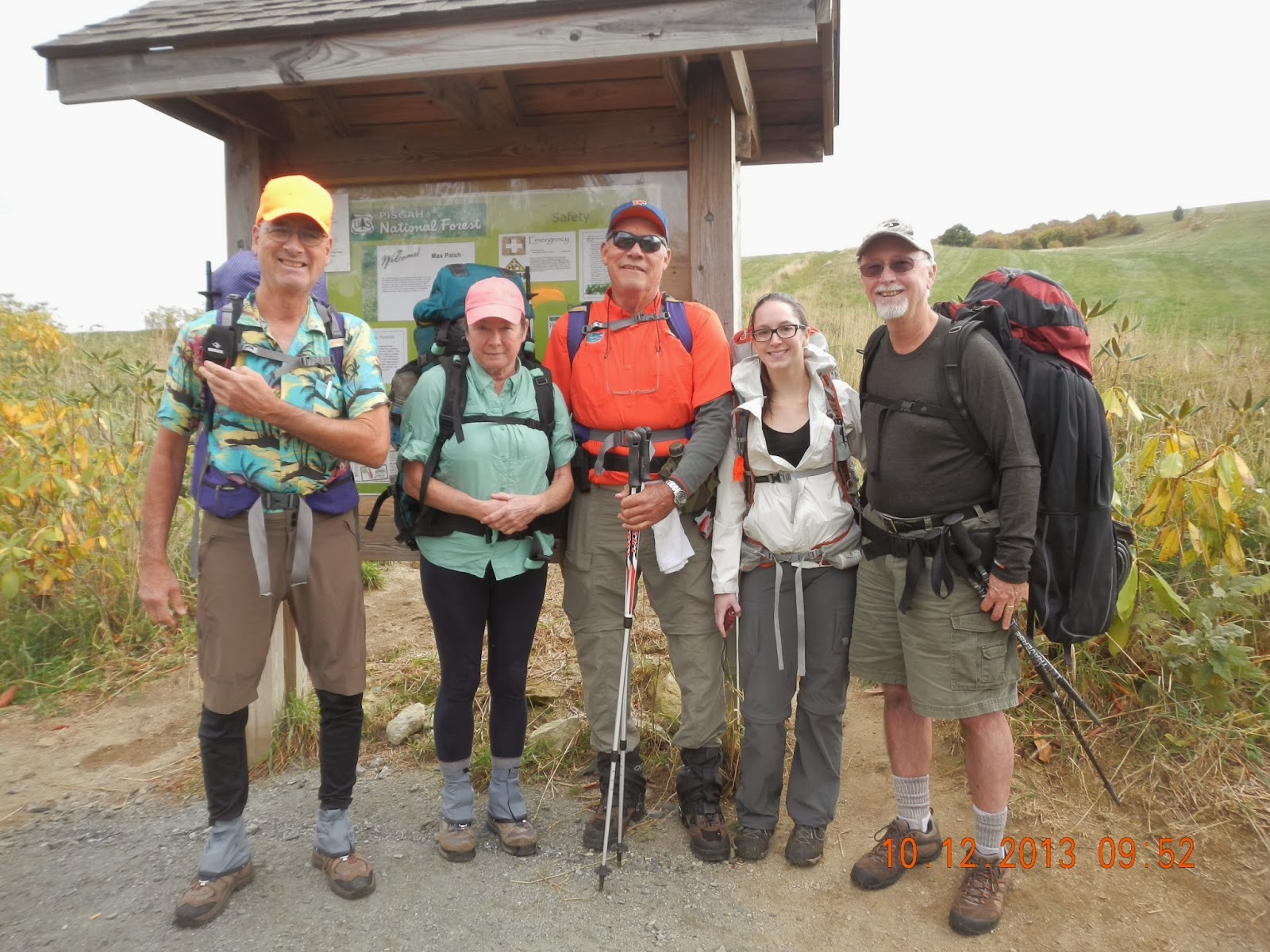
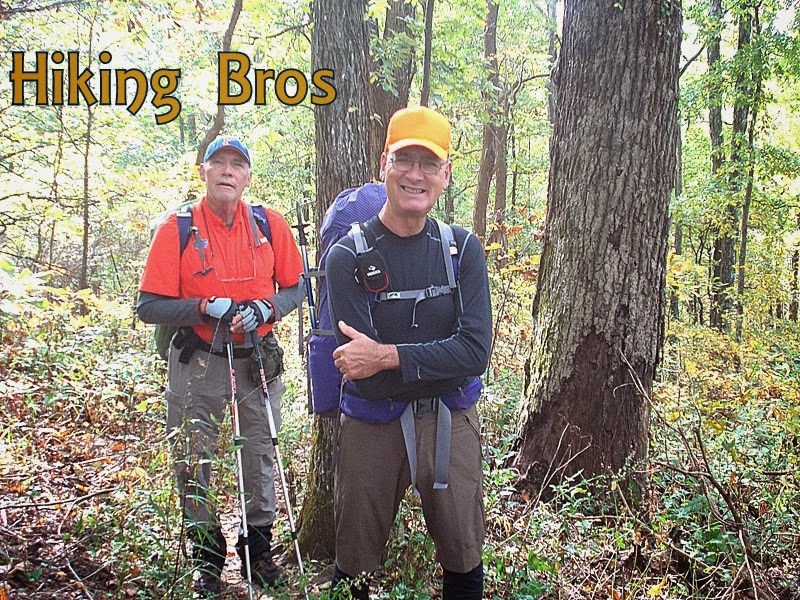
This hike included brothers Joe and Steve, niece Jenny, Peter and Catherine. In accord with AT custom, we assumed “trail names”. Joe was White Socks, Jenny was Juniper, Steve was Flatulent Frog, Peter was Eunoia and Catherine was Ladybug.

It is traditional to sign shelter logs with trail names. It was clear from the start that Ladybug and Eunoia would race to the back of our group. Young Juniper was the leader of the pack and carried a stick for clearing the morning spiderwebs. Thank you, Juniper. Frog and White Socks alternated next.


Eunoia, Frog, Juniper and White Socks played with various GPSs and other electronic toys. These modern marvels guided us along the AT, noting highlights (water sources, shelters, trail intersections) and topographical features.


These toys, more or less replacing paper topographic maps, were helpful in planning locations of over-night camps and meal stops. We didn't have to carry much water as there were multiple water sources along the way. You can see Ladybug and Juniper using a filter to collect water before one night's camp.


The temperature ranged from 50 to 75 degrees F, very pleasant. We did not need all the clothes and gear that we carried because it was dry and warm, but in the mountains one never knows. We also carried medical and first aid supplies that we were happy not to need. In the future, we will carry “fire-starter blocks” as making campfires with wet kindling was difficult. We were not troubled with insects, flying or crawling, thankfully.

This trip covered “only” 31 miles (ave 6.2 miles/day), but, with 30 pounds of gear and constantly changing elevation, some of us found it to be a workout. We felt every mile, believe me, and there was a steady demand from our band members for the aspirin and ibuprofen kept close at hand!

Bill Bryson wrote in “A Walk in the Woods”, “The hardest part was coming to terms with the constant dispiriting discovery that there is always more hill. Each time you haul yourself up to what you think must surely be the crest, you find that there is in fact one more hill beyond, …... and that beyond that slope there is another, and …. The elusive summit continually retreats by whatever distance you press forward, so that each time the canopy parts enough to give a view you are dismayed to see that the topmost trees are as remote, as unattainable, as before”.

Nevertheless, we did make it to the top of several mountains and the views were sensational: a boundless vista of wooded mountains, marching off in every direction to the distant horizons.


A day-to-day description of our hike follows.

Day 1 October 11, 2013
We began our Appalachian Trail Adventure at Hemlock Farms (http://www.hemlockhollowinn.com) where our group assembled in the afternoon. We enjoyed a delicious Catfish Dinner prepared by Mark, son of Hattie and Fred of the Paint Creek Cafe.


Eager for the hike, we discussed our plan, and compared packs and gear. We slept in their hikers' hostel, one room with sink and microwave, dining table, and 8 bunk beds (earplugs are essential). The bunk house overlooks Paint Creek. The Bath House is close by. The Paint Creek Cafe is elevated over the other side of the creek, with fish visible from the deck.

Day 2 October 12, 2013
Hattie prepared us for our first day of hiking with her famous breakfast. We knew we wouldn't see anything like it on the trail! Mark drove us to the start point of our hike, Max Patch, NC.


It had been raining steadily all week, even the night before, but as we arrived at the trail-head, the sun came out and so did the hikers for miles around.


Our trip co-coincided with the much maligned US government shutdown that closed the National Parks. This resulted in numbers of day hikers being diverted from nearby National Parks to Pisgah National Forest (not affected by the shutdown. you tell me why). We left the day hikers behind after the first few miles.

Max Patch is a bald mountain on the NC/TN border about 14 miles from Interstate 40. It is famous along the AT for its 360 degree view of surrounding mountains, namely Bald Mountain (which we climbed), the Unakas to the North, the Great Smokies to the South, and the Great Balsams and Black Mountains to the Southeast.


No one is certain about the origin of bald mountain tops. Theories have been postulated that these balds originated from aboriginal practice of fire ecology, or ice damage, invasion by gall wasps and/or grazing pressure by bison and domesticated livestock. Our Frog says it was named after Max, the horse, who lived on the Patch. Did I get that right, Frog? It is maintained now by periodic mowing.


We stopped for our first night after only 4 miles because of our late start and because we happened upon an idyllic campsite, vowing we would put in a good day's distance in the morning. We enjoyed eating together, a campfire and talk. Being an amiable group of hiking companions, we pretended to enjoy each others stories and laughed at each others jokes that, of course, we had never heard before. Fortunately, none of our group pretended that they could sing. However, the hooting owls were a special treat that we could not have surpassed.


Day 3 October 13, 2013
Rain overnight stopped at 0630. By 0900 we were on the trail.  We meet several backpackers today. The north-bound through-hikers passed by months before. We met a south-bound solo through-hiker. On the trail for weeks, but he did not smell bad. Disgustingly lean, muscular and fit except for the knee brace, he was happy to chat, as most solo hikers were.


EDITORIAL COMMENT: Ladies! Listen Up! There are solo men walking around on the Appalachian Trail. Go there to find them!


We were passed by two quick-stepping ladies from TN who were also headed for Hot Springs. They had “adopted” a young man from PA who had started in GA and was “section hiking”. This is a common occurrence. Hiking groups form, dissolve, and reform along the trail. We enjoyed a chat with this group of three.


On the other hand, we also encountered people zipping along with recorders on their arms (“fit bits”), who were keen to achieve their maximum speed and distance. They did not stop to chat.
The terrain was steep today, both up and down. The only more or less level place we found for our overnight campsite was on a forest service “road”, actually a dirt track for 4X4 vehicles. Pitching tents here we faced sudden death from speeding ATVs during the night! However, we were comforted by Thoreau, who wrote, “If a person is alive, there is always danger that they may die, though the danger must be allowed to be less in proportion as he is dead-and-alive to begin with.” Rather than watching “reality shows”, we were experiencing “reality” and “survival” daily! Would we be allowed on the show tomorrow?


Day 4 October 14, 2013.
We were up at 0630, and departed camp at 0845. Just before we walked away, a hunter in 4X4 truck, with dog in bed, drove through what a few minutes ago had been our campsite. Both dog and hunter were wired! Literally and figuratively. “Seen any bar?” This was opening day for BEAR Hunting in Pisgah National Forest.


Later, we came across another group of hunters waiting, hopefully, for the call from comrades that the dogs had sent a bear running toward them. We had a chat with them about the hunt; how it is a group activity, the role of the dogs, how they get any killed bear out of the forest and more.


Today's hike was a net downhill one, but plenty of up-slopes and no level terrain. At 1630 we arrived at the Iron Horse Inn after 9.2 miles that day. I thought my knees were going to scream. Everyone of our group was happy to arrive in Hot Springs, NC....bath, pizza, beer!


When we reserved accommodations at the Iron Horse Inn, we made sure that one of our rooms was equipped with a large whirlpool tub. We had been looking forward to that all day today, and it was every bit as lovely as I imagined. Juniper, Eunoia and I took turns in the tub, while Frog and White Socks were working hard at the laundry. Frog had earlier picked up the “food drop” he had shipped to the Iron Horse Inn so he would not have to carry it for the first few days. After all, WEIGHT IS CRITICAL when you're backpacking.

After soaking bodies and washing clothes, we went to the Spring Creek Tavern overlooking said creek for pizza and beer. We enjoyed sleeping in real beds. The Iron Horse Inn is a treat even if you aren't backpacking.

Day 5 October 15, 2013


At a hearty breakfast in the Smoky Mountain Cafe, we discussed how to deal with the particularly steep section of AT northbound from Hot Springs. The forecast rain was also a factor. We unanimously decided to take a shuttle from Hot Springs to Hurricane Gap, thereby skipping over the steepest section of the day's hike. This was an important part of our continuing recuperation from the longer hike of the day before, and enhanced our enjoyment of the day.

From Hurricane Gap, we proceeded at our leisurely pace, going through a diversity of forests. The Appalachian Mountains are home to one of the world's great hardwood forests, the richest, most diverse woodland ever to grace the temperate world.


We saw American Elm (few exist today), chestnut, hemlock, dogwood, red spruce, white pine, mountain ash, red, black, and white oak, sugar maple, black hickory, shag-bark hickory, giant magnolia, mountain laurel, and “tunnels” of rhododendron.

We camped early today not too far off the trail, as we had been told by south-bound hikers that the next best campsites north of us were already occupied. We liked stopping to make camp before dark so we could leisurely pitch our tents, made a campfire, eat dinner, rig our “bear hangs”, and generally lounge about.

Tonight we were snugly in our tents when awoken by a large group of hikers with flashlights coming along the trail in the dark looking for a place to camp. They sighted our tents and “bear hangs” and, disappointed, moved on into the dark, continuing their search for a site to camp.

We met that group the next morning. True enough, it was 14 students from Indiana State University taking part in an educational AT Mountain adventure. They had a group leader and they were delightfully pleasant young adults.

We chose not to stay in shelters, as they are infested with chipmunks, mice and squirrels, which can be night-long tormentors. The shelters do offer protection from the elements and usually a "bear hang". This is a wire stretched between two trees with a “collar” at each end to keep small critters out of food bags. Additional wires are suspended from the horizontal wire with snap swivels to attach gear. Food bags are hauled up 8 feet.

Day 6, October 16, 2013
Today we hiked along a series of narrow ridges with intervening dips into gorgeous, steeply sloped little valleys. On the ridges, the forest was thin enough for nice views of the adjacent mountains. There was a delightful breeze across the ridges. Walking into and out of the valleys we passed through stands of large hardwood trees which made so much shade that there was little undergrowth between their thick trunks.


There was plenty of bear “sign” where we stopped for the night on one of the narrow ridges.


 Because Frog selected this lovely site, we named it “Frog's Bear Scat Camp”.


Because we did not stay at the shelters, we made our own “bear hang” to lift food packs out of reach of bears.

White Socks had invested in a “bear canister”, that he also used as a camp seat.

Overnight, he placed the canister some distance away. We saw no bear and had no other “critters” invade our bags or tents.

There is other advice to avoid bear encounters: “don't sleep in clothes worn when eating”, “don't bring food into your tent” and “cook away from the tent site”. Some parks require you to use a bear canister, and we are considering buying one.

Day 7, October 17, 2013
Today it was a short hike back to Hemlock Farms, happy to find our stash of wine. There were welcome showers, dinner and packing of vehicles for the morning departure.

We are looking forward to hiking more of the AT, perhaps around Harper's Ferry, VA in the Spring. Eunoia and Ladybug have decided that 5 to 6 miles/day in steep terrain is quite enough for ourselves. Our biggest mistake of this hike was to have too many miles as a daily goal. The youngsters in the group forged ahead, which was fine as we met again at intervals. For us, rather to enjoy each minute of the hike than to cover great distances.


Many thanks to the Flatulent Frog, White Socks and Juniper for adding to our wonderful adventure and to White Socks and Juniper for contributing photos to this post. We will remember the good times on the trail when we're “old and gray”, in our rocking chairs!

We encourage all readers to get out into the mountains and GO HIKING!


Catherine and Peter