Our Overseas Adventure Travel Tour “Crossroads of the Adriatic”
continued into the countries of Montenegro, Bosnia-Hertzegovina and
Slovenia.
Montenegro
Montenegro
is a small, picturesque country that continues to attract the world.
Religious affiliations are diverse; including Orthodox Christians,
Muslims and Roman Catholic. Serbs and Croats are both of Slavic
origin.
Montenegro
uses the Cyrillic alphabet, and has been influenced by Turkish
invasions and migration of Jews from Spain. Languages include
Montenegrin, Serbian and Serbo-Croat. In spite of difference in
dialects and accents of their spoken languages, they can understand
one another. English is widely spoken among the younger generation
and in the tourist industry.


At
Perast, on the shore of the Bay of Kotor, we met our local
guide, Janya, and boarded a launch to the Church of Our Lady of the
Rock.
It is on an artificial islet constructed by expanding beyond
the original single rock by sinking ballast-filled captured ships.
The legend of how the local believers became motivated to construct
this islet and the church is mind-boggling. They believe that a
religious painting came miraculously to be in an opening in the first
rock at this site. This painting was “discovered” by a local
fisherman. To honor this “miracle”, it was decided to expand
beyond the original rock, construct an islet and a church. We were
shown the painting and the supposed original rock, now behind the
altar. The “rock” appears to be poured concrete.
“To see with
the eye of faith, one must close the eye of reason” (Thomas
Jefferson).
The
Bay of Kotor was optimally viewed from the launch. Click on the video below for a delightful panoramic.

David and Lou settled near the transom of the launch, from where they had a great view!

Peter took a
turn at the helm, steering the launch towards Kotor Harbour.
Risky business!
Risky business!

We noticed a lovely teal ketch, "Stephen S”, in Kotor Harbour reminiscent of our own “Charlotte D”.
There is good taste everywhere!
Kotor
has ancient city walls that reach 20 m in height and up to 16 m
thick. These walls and the enclosed old town of Kotor are part of
why UNESCO put this city on the list of world cultural heritage
sites. A walk to the top is for the very fit!
Click
on this short video for an appreciation of the magnificent walls of
St. Ivan's fortress.

The
soundtrack of the video exaggerates our climb.
However, Edo and Tom
did climb to the first viewpoint.
We learned about the Clock tower, begun in 1602 and not yet finished at the time of a 1667 earthquake. The tower had begun to lean, but since a 1979 earthquake it has returned to it's original position. During the Napoleonic siege, a clock maker was hired to service the clock. His descendants inhabit the clock tower to this day.
Adjacent
to the clock tower is a Romanesque church built in 1166 on the
foundations of a church from the 9th century. The tops of it's two
bell towers were destroyed by the earthquake of 1667. There were
only sufficient funds to fully restore one of the bell towers. The other
was replaced with a simpler structure, apparent in the photo.

At
the base of the clock tower is the “punishment pyramid”, where
law breakers were chained to be chastised by neighbours. Apparently,
the threat of this public embarrassment was sufficient deterrent in
most cases.
Tiny
St. Luke's Church, across from the Greek orthodox St. Nicholas
Church, was built in 1195 and is the only building not to suffer
major damage from earthquakes.
The
story goes that Saint Tryphon preserved a fleet of ships by
foreseeing a major storm and keeping the ships in port. . A
cathedral now honors him as the patron saint of Kotor.

Of course, we had to replenish ourselves after so much sightseeing.
While seated at this sidewalk cafe we were struck by the numerous same sex couples strolling to their
lunches. Edo explained that persons of the opposite sex do not go to
lunch together unless married to one
another. We don't understand all the demographics. This is the
first city where we observed young gypsy children begging.
Bosnia-
Hertzegovina
Bosnia,
established in 950, was conquered by The Ottoman Empire in 1461.
Four centuries of Ottoman rule influenced many Bosnians to become
Muslims, and the Slavic Muslim community emerged as the largest
ethno-religious group (51%). Other religions include Orthodox
Christian, Roman Catholic and Jewish. After WW I, Bosnia became
part of the Kingdom of Serbia, and, after 1929, Yugoslavia. Later,
Tito ruled as head of The Socialist Party.
Bosnia-Herzegovina
declared independence from Yugoslavia in 1992. After four years of
war among Croats, Muslims and Serbs, the Dayton Peace Agreement
created a multi-ethnic, democratic government. The economy was
severely affected and reconstruction has been slower than in Croatia.
We noticed many buildings war-damaged or destroyed.
Causes
of the war can be roughly grouped as economic, territorial (e.g.,
access to the sea for Bosnia-Herzegovina), and religious intolerance.
The transition from Socialist to a more Capitalistic economy would
have been difficult under the best of circumstances. Many industries
were developed during Tito's reign but too much of this
infrastructure was damaged during the 1990s war. Every time history repeats itself the price goes up!
Edo
was particularly knowledgeable, having lived in Croatia and Bosnia
before leaving for France as an eleven year old. He returned to
Croatia some years later. He worked hard to explain the complex
historical and current situation in the region, but our understanding
remains superficial. Many of the problems are common worldwide,
e.g., corrupt politicians, egotistical leaders, and voting fraud.
There is still a low standard of living and high unemployment. There
has been an exodus of young people, concerned that their future in
Bosnia-Herzegovina was not promising. Imagine the effects of this
exodus combined with the young lives lost during the war.
At
the small village of Pocitelj we went to our first mosque.
Turkish influences are evident (e.g., signs in Cyrillic alphabet). We
bought some souvenirs, and sampled the best pomegranate ever.

Bosnia-Herzegovina
is well known for it's cuisine, wines, spices and Turkish baths, as
well as gold and filigree work. We enjoyed the variety of local
dress (burkas, fez, belly-dancing tassels, and unisex long robes).
Our
next stop was Mostar, where we enjoyed a Turkish-influenced
lunch of “Hadzijski cevap” (veal, rice, vegetables), “Peksimet”
(salad, bread, cheeses, prosciutto) and “Hurmasice” (desert of
honey-nut pastry similar to baklava).

 We learned how to
drink the strong Turkish coffee: sugar added or cube dipped in coffee
(not stirred). After drinking the nearly solid coffee, turn the cup
over and your fortune is shown in the drained grinds.
We learned how to
drink the strong Turkish coffee: sugar added or cube dipped in coffee
(not stirred). After drinking the nearly solid coffee, turn the cup
over and your fortune is shown in the drained grinds.The Neretva River separates Muslim and Croat sections of the city. Consequently, the river demarcated one of the fronts of the 1990s war.

The famous Mostar
Bridge over the Neretva River, built 16th century, was
destroyed during that war and has now been reconstructed.
There is a
local custom of jumping from the bridge, especially on the
anniversary of the bridge destruction.
Click on the video below to witness a 20 m leap from the Mostar Bridge.

Of
course, the Neretva River was a battle line in earlier wars. We saw
the place where the movie “Battle for Neretva”, starring Yul
Brenner, was filmed. There is a plaque honouring Tito with his
words, "We will not leave the wounded". The railway
bridge was destroyed after Tito had transported his wounded to
safety. For the movie, the bridge was reconstructed and filmed collapsing into the river by explosives, where it remains today. There
is a museum honoring Tito's role in that war.
The
next large city toured was Sarajevo, capital of
Bosnia-Herzegovina, founded by the Ottoman Turks in the 15th century,
and flourished as a multicultural haven for Muslims, Serbs, Croats,
Turks and Jews, co-existing peacefully for hundreds of years.
Our
local guide, Denny, lead us to old and new sections of the city. We
were much impressed with the diversity of cultures in Sarajevo. We
viewed churches, synagogues and mosques.


One
mosque was particularly impressive, and it's somber interior was an
appropriate venue for our guide to enlighten us on many aspects of
the Muslim faith.
We must say that much of what he described was not
logical to us.
But what religion is logical?

 In
the central market there is a wide variety of European, middle
East and Asian goods for sale. Restaurants offer a range of “ethnic
foods”, however, the truly Muslim ones do not serve alcoholic
beverages.
In
the central market there is a wide variety of European, middle
East and Asian goods for sale. Restaurants offer a range of “ethnic
foods”, however, the truly Muslim ones do not serve alcoholic
beverages. 
 We did not miss the local favorite for lunch
“on-our-own” at sidewalk cafe.
We did not miss the local favorite for lunch
“on-our-own” at sidewalk cafe.
It is “chezapi” (veal sausages on pita with
shredded cheese).
Delicious with beer and wine.

The
architecture ranges from centuries-old, to 19th century,
to ugly socialist-era “housing projects”, to modern buildings
constructed in the past ten years.
Parts of the long-suffering city are quite attractive.
Street scenes are varied and often unique.
Our
local guide survived childhood during the 1990's war, and he told us
of many first-hand experiences during the siege of Sarajevo. He
described how, without electricity or gas, they cooked and heated
their homes by burning their furniture in home-made stoves after all
the city's trees were gone. We learned that alkaline batteries can
be “rejuvenated” by heating on a stove (if they didn't explode
first)! Water was carried in jugs from the few remaining sources,
while dodging sniper fire. He has many unpleasant childhood memories
of hours spent in dark basements during bombardments.
In
an attempt to make Bosnia-Herzegovina part of a “Greater Serbia”,
an “ethnic cleansing” policy was pursued by the Serbs. The UN
embargo on weapons left Sarajevo without effective armed forces. The
city was surrounded by Serbian snipers and artillery fired from the
hills above. Supplies of food, weapons, ammunition and other
supplies were becoming critically short. There was anxiety that the
city might become occupied by Serbian forces, with the continuation
of the “ethnic cleansing” already taking place in the
countryside.
In
desperation, a plan was conceived for a tunnel to pass under the
airport runway and the Serbian lines to friendly territory beyond.
Initial progress was slow and complicated by underground water, which
twice flooded the tunnel. The excavated soil and water were removed
with buckets and wheelbarrows. Eventually, construction brigades and
miners accelerated the project. The tunnel was completed on July 30,
1993, and was 800 metres long, 1.5 metres wide and not 2 metres high. It began and
ended in basements of homes on either side. Groups of up to 1000
persons, going one way at a time, carried sacks of food and weapons,
on the underground trek. Eventually, a tram line was installed. The
tunnel made possible the transport of fuel and power to the besieged
city, and allowed the government of Bosnia-Herzegovina to continue to
function during the siege.


We
learned all this at the Sarajevo War Tunnel Museum, which preserves many items used during construction of the tunnel. We
passed through a 20 meter section of tunnel. Films were shown of the
siege. We were moved!
In
August, 1995, NATO finally intervened after the deaths of an
estimated 200,000 people, including 11,000 Sarajevans. Peace
returned to Sarajevo, but signs of the recent war remain obvious
today in buildings destroyed or pockmarked from shell fire. The
culture will be scarred for a longer time.
“You
may not be interested in war, but war is interested in you”.
Leon
Trotsky (Marxist Revolutionary, 1879-1940)
Later
that evening, we enjoyed a home-hosted dinner with the extended
family of Sida in their apartment built by the government during the
socialist era. We are greeted warmly by the family as we took off
our shoes. The daughter-in-law spoke English, and we learned of
their working lifestyles and the lives of children today. In spite
of their austere lifestyles, their attitudes were positive and
hopeful. They will persevere. We received gifts of artwork from the
young son. They shared their dinner with us in their compact
apartment which Sida was able to purchase after Tito's death. Sida's
son and his wife and two children cannot afford to buy their own
apartment. Jest was made of the generous “Wicked Mother-in-Law”,
a kind of universal joke.

For
more information on Bosnia-Herzegovina: http://www.bhtourism.ba/eng/
Slovenia
Slovenia
was part of The Austro-Hungarian Empire until its dissolution at the
end of WW I. In 1918, they joined the Croats and Serbs to form the
new Yugoslavia. Slovenia secured it's independence from Yugoslavia
in 1991 after only tens days of warfare.
Slovenia
has historical ties with western Europe (English is commonly spoken),
a strong free market economy and a stable democracy. They have made
a successful transformation to a modern state, acceding to NATO, and
part of the EU since 2013.
There
is a diverse economy, including the wood industry, Elan Skis, Gorinji appliances, Renault autos, and nuclear power. They
enjoy a high standard of living. There is a volunteer, professional
military.
Eighty-three
percent are native Slovenes, and the remainder Serbs, Croat, Bosniak.
Religious affiliations include Catholic, Orthodox Christian,
Protestant Christians, and Muslim.
Our
first stop in Slovenia was the Postojna Cave, for 140 years
the only cave in the world which featured a double track railway
passing 5 km into the cave, under spectacular underground arches,
which are embellished with chandelier-looking stalactites, through a
beautiful subterranean world of natural limestone formations. One of
the most magnificent sights is the mighty River Pivka flowing into
the depths of the cave. Postojna is regarded as the cradle of the
scientific discipline of speleobiology.

A
short bus ride brought us to Ljubljana
and our lodging at the impressive Grand Hotel Union. The hotel is
modern, clean, and well-maintained.
The rooms are spacious, luxurious and "well-appointed". The staff are courteous and available.

The included
buffet breakfast was sumptuous, with many and varied delicacies.
Every breakfast was different, but all equally delicious!
Our
local guide, Kriri, introduced us to the city centre. At the statue
of France Prešeren (national poet, 1800-1849) in the old town
square, Kriri recited his famous poem for us.
“God's
blessing on all nations,
Who
long and work for that bright day,
When
o'er earth's habitations
No
war, no strife shall hold its sway;
Who
long to see
That
all men free
No
more shall foes, but neighbours be”

Ljubljana
appears to be a very livable city, is a University town, and boasts of being the most ecologically green capitol city. We could believe it after exploring
the pedestrian centre.


There are free tourist assist "golf carts" to help you home with your newly purchased luxury goods, and
bicycles to rent.

We saw our first wooden bicycle!
We enjoyed walking the lovely cobbled streets to view Tivoli park and castle, bridges, statues, churches and cathedrals. Many shops offer luxury goods. Ljubljana is a University town.


The pedestrian centre has a terrific outdoor market with crafts, fish, meat, pastry, flowers, sauerkraut, and most unusual cauliflower among the produce offerings.

There are countless eateries and numerous street entertainers.

We sampled sausages made from bear, horse, deer, and wild boar.
Notice the uncovered slabs of smoked meats and sausages at this outside food stall.


We
marveled at a unique machine dispensing fresh, raw milk.
Unfortunately, these “street foods”, including the raw milk
dispenser, are now threatened by the gradual implementation of EU
rules on food hygiene. The Slovenian culture will be altered by EU
membership.

There are numerous opportunities for wine tasting scattered around the pedestrian centre.
So much wine! So little time!


On
the periphery of the pedestrian zone there is underground car parking
and pedestals for charging your electric car, along with
well-developed bicycle lanes.
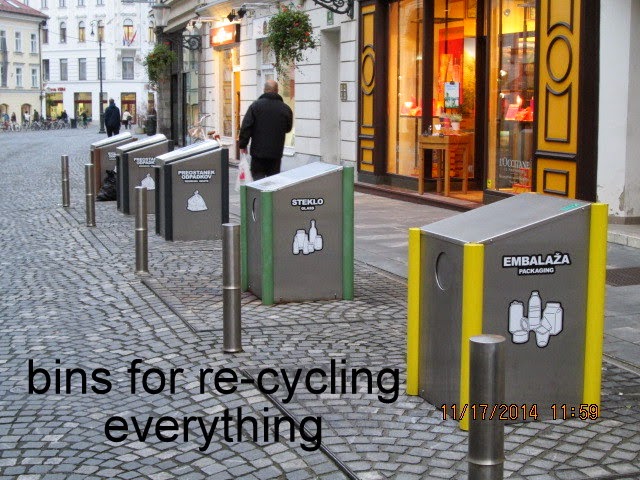
We were impressed with the availability of bins for recycling.
Neat and unobtrusive.
We visited the National Museum of Slovenia, the Natural Science Museum and the City
Museum.
We learned about the influence of The Roman Empire in Slovenia, and
some of the archaeological finds dating from 5000 BC. We heard of “Emona”, the ancient
Roman Empire city, which developed from a prehistoric lake-dwelling
settlement to the modern urban Ljubljana of today. There is also the
National Gallery of Art, another for Modern Art, and one of the
oldest philharmonic orchestras in the world.
We
enjoyed an extraordinary lunch, “on-our-own”, at Gujzina. Their
white Riesling wine and Bevog draft beer are fantastic. We had
Prekmurski Bagrec (goulash with pork, veal, venison, and potatoes),
Bujta repa (pork with sour turnips and millet), prekajena gosja prsaz
grajon (smoked goose breasts with rampion), and desert of prekmurska
gibanica (strudel with walnut, apple, poppy seeds, cottage cheese
filling). Coffee was followed by jurka (Slovenian red wine liquor).
Here food is close to a religion! And we were happy to subscribe!
The
next day we visited Lake Bled, a glacial formation.
Definitely one of the scenic highlights of our visit to Slovenia!
Wonderful skiing in the area. http://www.bled.si/en/


We boarded a pletna launch to cross Lake Bled, passing Tito's summer place, to reach Bled
Island, the only island in Slovenia.


St. Mary Magdalene Church dates from the 9th century, renovated many times but still
with original foundations.
The wishing bell and climb to the clock tower were fun.
The wishing bell and climb to the clock tower were fun.
In the gift shop/bakery we learned how to make walnut
potica, drizzled with rum. This is a traditional pastry, a must for
every holiday in Slovenia. The filling for this exquisite pastry is
entirely up to the baker's creativity – with as many delicious
potica fillings as there are cooks.
 We
explored Bled Castle, one of the oldest in Slovenia, first mentioned
about 1000. It is perched atop a cliff above Lake Bled. On the upper
level there is a chapel from the 16th Century. Inside the castle
there is a museum of local history from The Bronze Age to more recent
times, when steam-engine trains brought tourists for mud packs and
hot spring baths.
We
explored Bled Castle, one of the oldest in Slovenia, first mentioned
about 1000. It is perched atop a cliff above Lake Bled. On the upper
level there is a chapel from the 16th Century. Inside the castle
there is a museum of local history from The Bronze Age to more recent
times, when steam-engine trains brought tourists for mud packs and
hot spring baths.
Check
out Bled Castle
www.bled.si/en/what-to-see/cultural-sights/the-bled-castle
 At
Radovijika we stopped at the Lectar Restaurant and Gingerbread
Museum, to learn the process of producing and decorating gingerbread.
Catherine bought some “special” souvenirs.
At
Radovijika we stopped at the Lectar Restaurant and Gingerbread
Museum, to learn the process of producing and decorating gingerbread.
Catherine bought some “special” souvenirs.
After lunch the
owner and his son treated us to some Slovenia music about a
beekeeper.

On
the way back to the hotel, Edo favoured us with cherry brandy.
 We
said farewell to Tony, our driver, who guided us safely over many
miles of often narrow roads. Thank you, Tony.
We
said farewell to Tony, our driver, who guided us safely over many
miles of often narrow roads. Thank you, Tony.Our group shared farewell drinks at the hotel before walking out to dinner. We were greeted by Slovenian dancers and accordion player and, of course, an aperitif outside on the pedestrian mall.
After
dinner, we had lessons in Slovenian dancing, which we enjoyed immensely, as you can see from the video.


The
next morning we said our farewells to Edo and all our new OAT friends, who
soon departed for diverse destinations.
After
goodbyes, we hiked to the bus station for our ride to Venice
to continue our adventure near the shores of the Adriatic Sea.
Our visit to Venice will be the subject of our next posting.
Our visit to Venice will be the subject of our next posting.
Catherine
and Peter,
now
aboard S/V “Charlotte D” in the Southern Caribbean.


