Wednesday, November 16, 2016

Wilderness Beyond; Patagonia, Tierra del Fuego and Chilean Fjords

Well, Overseas Adventure Travel (OAT) did it again! 

They continue to amaze with the quality of their tours and this, our fourth adventure with them, did not disappoint!  Our dream for years was to visit Cape Horn by ship.  This 14 day tour was the perfect combination of outdoor activities, scenery and excitement.

Many thanks to our fellow travelers, especially Judy, Mike, Ed and Lena, for their magnificent photography which will continue to bring this adventure alive to all who enjoy this blog.  Thank you.


We arrived in Buenos Aires at the Amerian Park Hotel. We met our bird expert, and trip leader, Raphael de Biase, and 13 other travelers from Texas, Florida, Tennessee, New Mexico, Minnesota, New Hampshire, Illinois, Washington, Colorado and ourselves from Canada. We even had a father/daughter team, Chuck and Kristi.


First day activities included a tango lesson (click video), a welcome dinner at a family-run restaurant with "secret" tunnels to the harbour.


The next day included a tour of the city.  Highlights were the beautiful homes of the Recoletta section, and the Cemetery where many famous people including Eva Peron were entombed. 


We were introduced to facturas, a delicious pastry


We visited the pink Presidential Palace behind the "protest wall" as well as the artsy Boca District. They are fond of their futball teams.  Peter bought a souvenir "Messi" futball jersey.

Political demonstrations are common, peaceful and accepted.   That being said, the traffic jams in Buenos Aires were hard to beat.

Education through the undergraduate university level and most healthcare are free.

The currency denominations are confusing and unfamiliar.


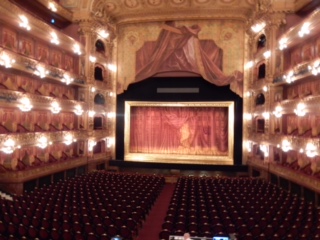
We visited the Colon Theater, one of the world's most famous.


Our day ended with a Home Hosted Dinner with our travel colleagues, Mike & Carol.  We learned at least one individual's opinion on local  and world politics, religion, and women's roles in South America.

Next morning we flew to Ushuaia which is the name the Yamana, the indigenous people, gave to their settlement, which means "bay that stretches into the sunset".   The Yamana are almost extinct.

But what a picturesque harbour!  Some handsome sailboats and scenery.


We stopped to meet Gaby and Gustavo for a snack before settling into our Celine Hotel.  Gaby shared recipes for her magnificent presentation which included spinach Parmesan bolle, lentil soup, and three milk cake.    They have charming daughters and live in a unique home on the hillside of Ushuaia.


That evening we feasted on a dinner of king crab, salad, Cape Horn Beer, and Alamos Savignon Blanc.


Jim and Lynn enjoying a Cape Horn.


Ushuaia began as a penal colony, and there is an interesting Prison museum where we learned that, as in many other countries, inmates were used to build railroads, roads, and were poorly cared for.

Mike counsels a prisoner while Peter pleads with the warden!


Our local guide, Valerie had arranged to have a presentation by a veteran of the 1982 Malvinas War.  The other controversial topics include the thousands of children who were taken away from their homes during the military dictatorship of 1976-1983.

Later,Valerie introduced us to Tierra del Fuego National Park where we enjoyed two short hikes and explored the end of the South American Road System, Route 3.  


We learned that Argentinians and Chileans love their chocolate shops which are second to none.


We were introduced to mate cups and Yerbe mate, which is a social herb to be enjoyed among friends.  You need to carry a mate straw, a thermos of hot water and keep it refreshed often.  A great souvenir.

Then, it was the time for us to be boarding our ship MV Via Astralis which was waiting for us at the port.


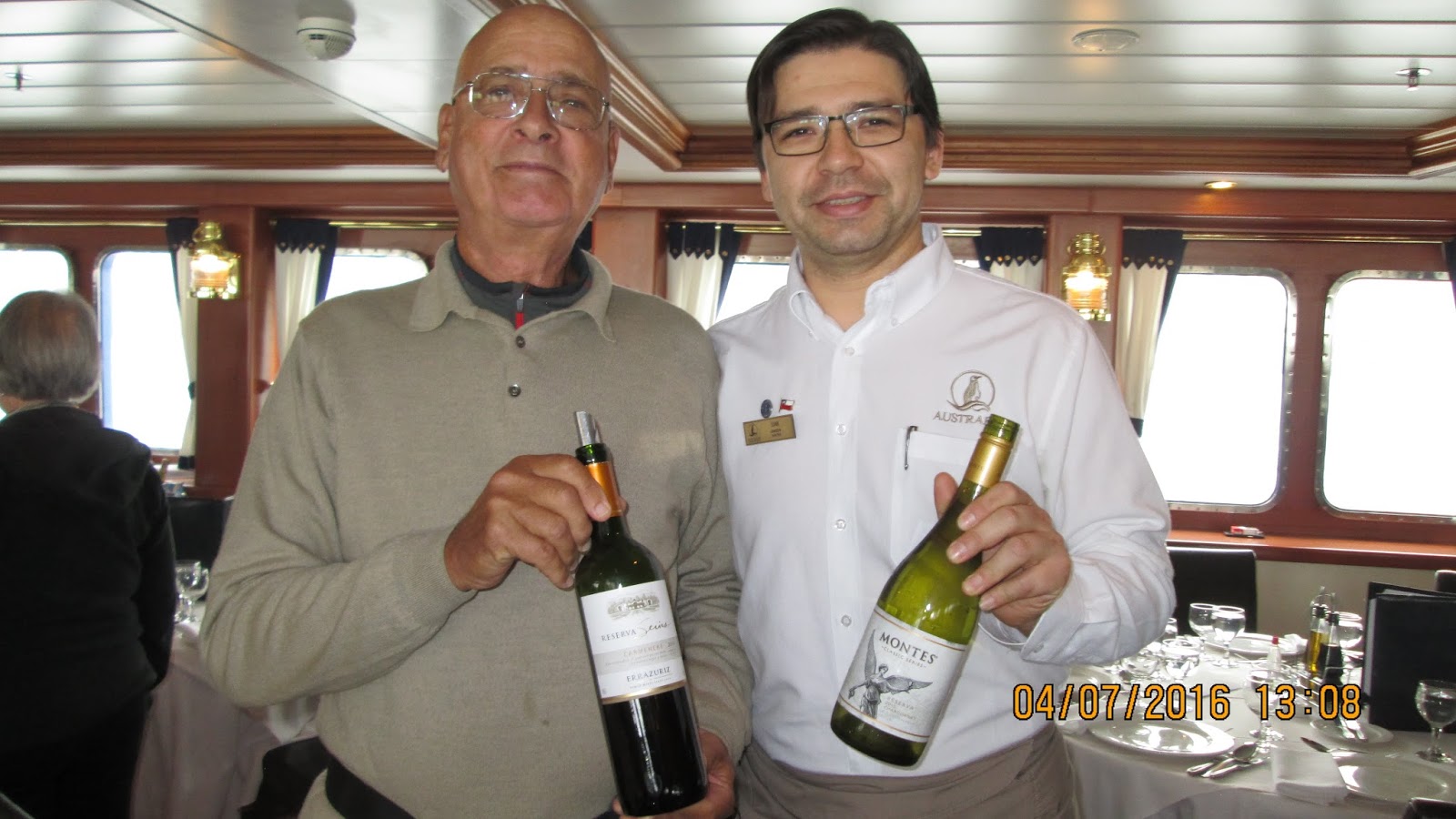
We were provided with a delicious welcome dinner and drinks.  We were introduced to some lovely refreshments: Fuegian Beagle roja Pale Ale, Montes Savignon Blanc, Leyda Valley (Chili) and Astral Calafate ale.

Of course, there were the obligatory safety sessions, and daily instructions about what we would experience the next day, as well as naturalist and historical films of Cape Horn and the Chilean Fjords.  Rules were strick: no landings when wind is over 30 knots, seas more than .5 meter or a surge on shore.  Life vests were on pegs with room number tags to ensure everyone returned to the ship after an expedition.  The staff was exceptional!


 Our wonderful waiter, Juan.


MV Via Astralis has been sold to National Geographic trips to the Galapagos.  We did send them off well with an auction of the ship's flag and navigational chart of our trip.


During the night Australis rounded the Beagle and Murray Channels to Walaia Bay, part of the Cape Horn National Park, which was once the site of a large native settlement.  Walaia Bay was visited by Charles Darwin who landed and described it's very unique vegetation and where the Atlantic and Pacific meet.  It was here that we were officially entering Chile as all our passports were collected and stamped by officers who came to our ship.


Overnight, we traveled to Cape Horn.  We woke to a position of  55 deg 56 min, 67 deg 19 min, the end of the world, fin de monde, 2400 km from Cape of Good Hope.  This is the area of the "roaring 40's (knots).  Cape Horn is a 2005 UNESCO Biosphere Reserve and part of Chili Navy.  We met the Navy Captain and his wife who with their 2 young daughters have agreed to a one year lighthouse stay.  The purpose of the Chili Navy is to maintain sovereignty and navigational lights.


The Captain and his wife live for one year
in the lighthouse with their two  daughters.


We have to confess, that we had perfect weather, the entire trip.  Our trip leader made us swear not to tell everyone about how beautiful our weather was, because many shore expeditions are cancelled because of inclement weather.

Cape Horn was discovered by the Dutch.  Tough sailing in the 1890's.  In 1906, 2500 clipper ships joined the Fellowship of Captains of Cape Horn. There is a monument of an albatross to celebrate this auspicious meeting.

I am the albatross who awaits you at the end of the world.

I am the forgotten soul of the dead seamen who sailed across Cape Horn from all the seas of the world.


But, they have not died in the fury of the waves; today they fly on my wings, toward eternity, in the last crevice of the Antarctic winds.


written by Sara Vial, poem in memory of the sea men who lost their lives crossing Cape Horn.

Morning led to the Glacial Alley and Pia Fjord and Glacier.  We walked along the metamorphic rocks along the shore and climbed an overlook to view the glacier calving.  Later, we visited the Garibaldi Glacier.  We enjoyed multiple evening presentations and survival island documentaries of South Georgia Island.

We continued our passage through the Beagle Channel sailing west along the southern edge of Tierra del Fuego.  A number of impressive glaciers flow down the Darwin Mountain Range.  The Pia Fjord is very narrow for a zodiac visit  to the Pia Glacier which extends from the mountaintop to the sea, so we stayed aboard for a panoramic view of this spectacular glacier.


Each day we viewed the screen where our course had been plotted.  We encountered some big seas rounding the Magdelena Channels and Breakneck Peninsula on the Pacific side finally arriving at protected Chico Sound.  We disembarked in zodiacs with our naturalist to the Alakaluf Fjord to see Pilota (blue) and Nena Glaciers.  We went past a beautiful water fall where our naturalist was baptized.


We visited Pia Glacier and Glacier Alley.  We went ashore and imagined a drop of water flowing from the Darwin Mountain to the Sea.  We experience calving glaciers, which makes a huge thunderous sound and then surge of water as the chunk of ice drops.  Glaciers are receding at a record pace today.


After every zodiac expedition, we enjoyed hot chocolate with Johnny Walker Red Label Scotch Whiskey by our outstanding bartenders.  Miss Vickie is enjoying!


Peter enjoyed the tour of the engine room with 385 hp engines, etc.


Rafa pointed out flightless steamer ducks and juvenile birds that waited too long to head north, sadly they will not survive.  The penguins that we didn't see, had already flown north.
Does it get any better?  Next visit was to Chico Sound and Aguila Glacier and the Magelanic forest.  We visited the  Pilato Glacier by zodiac which is considered "blue" in color.


 The zodiac drivers were real "cowboys" riding the ice flows and keeping us safe at the same time.


There was never a time when we were cold.  We had been given the advice by Rafa, dress like an onion, in layers.  We were warm as toast even with all the icebergs and glaciers around us.


Magellenic forest.
We went on to Punta Arenas where we cleared into Argentina again and were joined by a local guide who showed us the town's highlights before we boarded a bus to Puerto Natalas.

Enroute we stopped at a terrific Argentinian style Barbeque, delicious!


We used this opportunity to shop for headgear.  Lena models one suited for her Florida lifestyle and Peter looks handsome in his boino, guacho hat.


We stopped for a break at a place called "Esperaza" where we could buy a good cup of coffee or chocolate.  I bought some "submarino"s for our granddaughters which I hope to present them one day to be added to hot milk for hot chocolate.

We stayed at a lovely hotel in Puerto Natalas, also known as the home of a prehistoric giant sloth.  Our hotel faced the Senoret Channel which formerly was a big port but because of the preference of air travel to ships, the harbour is very quiet.  We enjoyed lovely sunset and sunrises here and they had unique statue art of flying girls and boys and a neat skateboard park.

 Sunrise and sunsets were amazing here!   This is a beautiful sculpture at a skateboard park.

We traveled next to Torres del Paine National Park, another UNESCO World Biosphere Reserve.


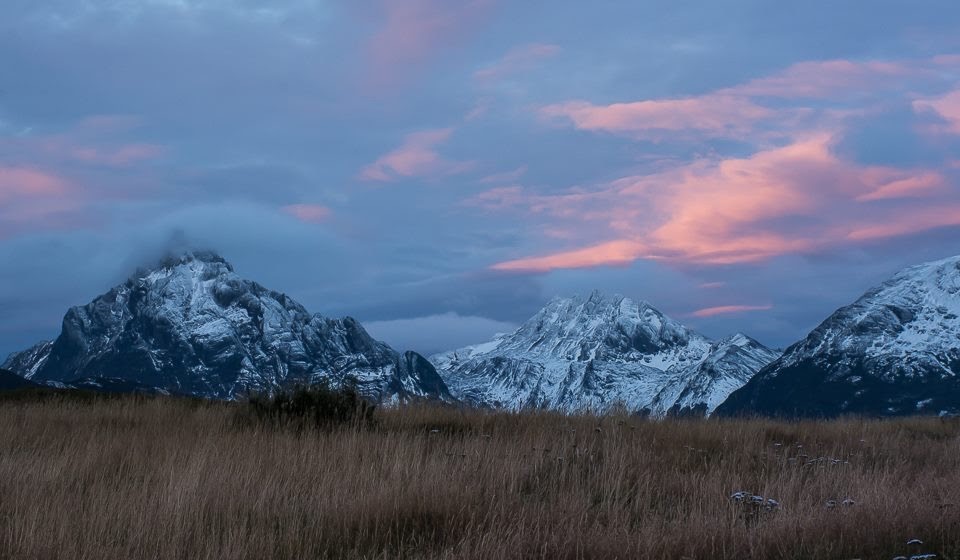
The Patagonian steppe meets the Paine Massif and the topography is breathtaking.  Here we met the Andean Condor, the Guanaco, the Patagonian Gray Fox, numerous Eagles and Hawks and the Crested Cara Cara. The Ghea or Nandu (an ostrich like bird) was sighted with sheep.
We never spotted a Puma but we saw the Puma kills.  The Condor only approaches dead animals and they are abundant and also beautiful pilots.


We stayed at a most beautiful hotel.  We each had lovely rooms overlooking the mountains.  We were introduced to "Pisco Sour",  Catherine's favourite cocktail.

We enjoyed a lovely hike today to include the Salto Grande Waterfall, and learned all about the many grasses and berries.


We even had an opportunity to ride horses with a gaucho, enjoy phenomenal sunsets and waterfalls.


Glorious desert tables


The Calalfate bush is used for teas, jams, and countless other delicacies.  It is said that if you eat the berries, you will return.


Climbed to ancient petroglyphs.


Torres del Paine is too beautiful for words!

Can you see the gauchoe on the left?  Calafate below.


 We learned that, like many other countries, introduced species have had disastrous consequences on their fragile environment.  There are measures being introduced to bring foreigners in to extinguish beaver, mink, goat...


Another precaution that is being taken seriously by park service providers, is to restrict campfires. The park is still recovering their great quantities of fragile trees from a uncontrolled campfire years ago.  They now  require a tour guide to regulate attendance in campsites in these fragile ecosystems.

Our guide, Carolina taught us many things some of which included politics, dog control, cost of living and ownership of land.  The lateral morain 25 thousand years ago covered what is natural oil & and gas sources.  Argentina is rich in natural resources.

We traveled from Torres del Paine to El Calafate, a long bus ride.  We were welcomed by the hotel staff at and then enjoyed walking around the town.  The Argentinean gelato parlours are phenomenal.


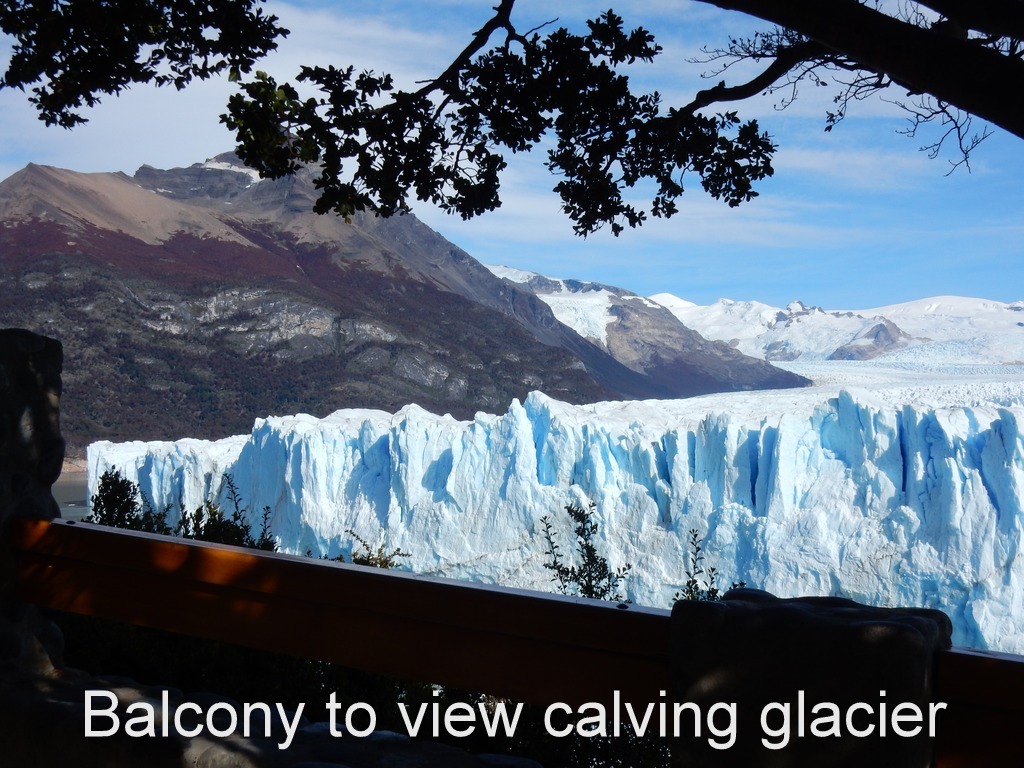
We visited Perito Moreno Glacier in Los Glaciares National Park, another UNESCO World Heritage Site.  There are 50 large glaciers forming around 5,000 ft which is unlike glaciers much higher elevation.  The calving here and the boardwalk and balconies to view the glaciers were lovely.

 We enjoyed a bit of Fall colours here with the white Birch and Cherry tree forests.


Our visit to Los Glaciaris National Park was spectacular and the Perito Moreno Glacier did not disappoint.

Back in El Calafate, Rafa offered to give us a tour of the Sendero Laguna Nimez and point out the hundreds of bird species.


Shortly after we flew from El Calafate to Buenos Aires.  We saw a spectacular Tango Show that evening and enjoyed a Farewell Dinner.


Our final day we explored the Parana River Delta.  This was a get-a-way for the rich and famous years ago and is only accessible by boat.  Homes, Schools, Postal Service, Hospitals, Stores, Restaurants, all on stilts, are reached by boat. The Para Delta empties into the Rio De la Plata and on into the Atlantic. Waterways are a bit twisty and high-speed for my tastes but it appears to be enjoyed still by many Argentinians.


A million thanks to our birder and wonderful trip leader, Rafa !  What an adventure!

Salud, pesetas y amor!  Y el tiempo para gozarlos
.....toast made famous by our fellow OAT traveler, Ed!  Gracias!


Saturday, December 19, 2015

Report from the Saddle: Second Bicycle Tour 2015

The Ride is in two distinct parts: the C&O Canal and the Great Allegheny Passage.

Part 1 is along the towpath of the former Chesapeake and Ohio Canal, from Arlington, VA, to Cumberland, MD, a distance of 198 miles, paralleling the Potomac River, the water source for the canal. The towpath was constructed for the mules that pulled the barges along the canal. There are numerous locks to raise the barges from sea level at Washington to 605 ft above sea level at Cumberland, MD. Between locks the path is level. Once outside the environs of Washington, the cycle path is an unpaved “two tract”, wide enough for two bikes to travel abreast. The surface is not smooth, having been invaded by protruding tree roots and featuring numerous “pot-holes”.

This part with the towpath along the canal is the C&O Canal National Park http://www.nps.gov/choh/index.htm. There are numerous Park camp sites and commercial campgrounds along the entirety.

Part 2 is a rail-trail along the former rail bed of one of the lines through the Great Allegheny Passage from Cumberland, Md, to Pittsburgh, PA, an additional 152 miles http://www.atatrail.org/. Partially paved, and smoothly-graded and hard-packed where not paved, the rail-trail climbs steadily from Cumberland to the Eastern Continental Divide, a total climb of 2,392 ft from Washington. From the Divide, it is mostly downhill to Pittsburgh, PA, a net decline of 1670 feet from the Divide.

The total distance cycled from Arlington, VA, to Pittsburgh, PA was 350 mi. over seven consecutive days. And that, folks, is an average of 50 miles cycled per day!

The Tour Company we used is Adventure Cycling Association.

This was a fully-supported ride. There were 37 paying riders from 20 states plus us from Canada. There were seven support staff. We camped in our own tents and sleeping bags that were transported by truck to each campground. Bob Westgate was our Tour Leader. Chris was our luggage handler and truck driver. We rode with an experienced bicycle mechanic, Don. 
Various support roles were pleasantly filled by Sue, Karen, Val, and George. All the staff cycled for on-trail moral support and rotated responsibility for the twice a day “Nutrition Breaks”. There was always a staff member cycling at the end of the pack, to “sweep” the trail for stragglers (often Peter and Catherine) and recover the directional signage. On more than one afternoon we unapologetically used the “Sag Wagon” on the sometimes steep final approach to the campground.

Breakfast and dinner were catered at the campgrounds by Anne and Serge of “Culinary Insider”, traveling with an professional kitchen in an 18 ft trailer. The meals were spectacular, fresh and varied.   http://www.culinaryinsider.com/  


This tour was fast-paced, to put it mildly. In the mornings we followed a 6-7-8 schedule. Up at 6 AM to knock down tents and pack gear for the luggage truck. Breakfast at 7 AM. Make and pack our own lunch. In the saddle by 8 AM. In the evenings it was also a 6-7-8 schedule. Dinner at 6 PM after having set up tents. “Map talk” for the next day at 7 PM. In the tents by 8 PM to sleep deeply after the day's exertion.

Our group included riders more experienced than us. Several of them, even more aged than us, cycle well over 1000 miles per year. We were shamed by their fitness levels and their cycling performance. Their comfortable pace of riding brought them into camp much earlier than us, so they had more time for socializing in the afternoons than us laggards who frequently arrived just in time for dinner. This was our longest ride to date, and we are motivated to improve our fitness year-by-year, so as to increase our enjoyment of such tours as this.  "If we had known that we were going to live this long, we would have taken better care of ourselves."

Our co-rider, Ed Wojtaszek, has posted on his blog, Edek's Attic, a day-by-day description of the ride, ACA C&O Canal and GAP Tour 2015 http://ow.ly/TAvZY. We refer you to his post for that description, which we will not repeat here. Instead, in our post we describe what were highlights of the ride for us.

There was a mass start from the hotel in Arlington. The group rode together to the National Mall for the traditional “start photo” on the steps of The Lincoln Memorial.


Still in the Mall, riders dispersed to various monuments and memorials, including the Vietnam War Memorial, where Catherine is, of course, always drawn to the Memorial to the Military Nurse. This statue portrays two battlefield nurses, with wounded soldier, anxiously awaiting arrival of the medi-vac helicopter.
In the vicinity of Washington, the towpath is busy with walkers, runners, bicyclists, backpackers, and families with dogs and strollers. There was even a group doing Yoga on stand-up paddle-boards in one of the Canal Lakes. It was pleasing to see so many enjoying the Great Outdoors! During the first day, as we pedaled northwest, the towpath traffic thinned out quickly and we soon found ourselves in a more rural habitat.
We enjoyed the remnants of the locks and the well-preserved lock keepers houses, some in very attractive locations between the Potomac River and the Canal.
There was socializing at the Nutrition Breaks and along the towpath at various highlights such as dams, bridges, and aqueducts.

Don drew our attention to a patch of Paw Paw trees with fruit just ripening. Very tasty! Catherine remembers learning the song, "The Paw Paw Patch" as a child.

The ride along the towpath was spectacularly scenic. We pedaled through a lovely hardwood forest, in the early stages of fall colours, often quite close to the Potomac River. By this point the bike traffic was very light, so we often had the forest to ourselves.
It was obvious that the remains of the canal provide a wonderful natural habitat for deer, rabbits, squirrels, birds, turtles, fish, and frogs.

Each evening we re-built our tent city. 
We gathered with beer or wine to share our experiences of the day's ride while dinner was in preparation. There was much conversation of features of bike models, but we still don't know who makes the best shifter! Meanwhile, Don, our mechanic was busy with cleaning, lubricating and repairing bicycles. There were numerous flat tires experienced in our group, but fortunately, our puncture-resistant tires performed as advertised (or we were just lucky).
The Paw Paw tunnel was a highlight. National Park Service Ranger Rita Knox gave us a nice summary of the construction and history of this 3,118-foot (950 mlong tunnel allowing the canal passage through the mountain. We walked our bikes, using head and tail lights, along the towpath through the tunnel as it was too narrow and dark to ride. Just imagine the mule handler and mules pulling the barges years ago, hoping no one is entering at the other end. There must have been some way to coordinate traffic in those days before cell phones!
Among historic sites along the C&O Canal are Harpers Ferry http://www.nps.gov/hafe/index.htm and The Antietam National Battlefield http://www.nps.gov/anti/index.htm . As we have previously visited these sites, we did not linger this time.

The C&O Canal terminates at Cumberland, MD, where we enjoyed a night in a hotel, especially the tub full of hot water! Riders dispersed in small groups to numerous nearby restaurants.
The next morning we made the transition from C&O towpath to Great Allegheny Passage rail-trail. The rail-trail passes through, or near, more communities than does the C&O towpath. These communities provide a multitude of services, including commercial and free campgrounds, bicycle rental/repair, canoe/kayak rental, lodging, grocery stores, and restaurants. The GAP rail-trail would be doable as a B&B to B&B ride.
The first day on the rail-trail was the toughest, an ascent of 1785 feet to the Eastern Continental Divide. Advertised as a “modest” grade, we found it exhausting, and were pleased that the later afternoon was a steady descent to our campground.


There is still much rail traffic close to, sometimes very close to, the rail-trail. In particular, this made for some noisy campgrounds, with trains being made up or passing throughout the night.


However, all the campgrounds were scenic and we had some very pleasant evenings.
Click on this video for a sample of campfire entertainment. Yes, the video is too dark, but the sound track of the live music is terrific.


The scenery along the rail-trail was simply splendid. There were many attractive long views where we rode alone or in small groups. 
There were also lovely forested sections.

Particularly attractive were the numerous rail bridges converted for use by bicyclists. Click on this video for a sample.


Near Ohiopyle, there was a side trip to the Frank Lloyd Wright-designed home “Falling Waters”, famous for it's spectacular cantilevers over a natural watercourse. The tour of the interior (no photos allowed) was well-presented and highly informative.

Eventually, we arrived in Pittsburgh, where bikes, luggage and riders boarded trucks and buses for the return to Arlington.


We definitely recommend this ride and, in particular, were pleased to have done the trip with Adventure Cycling Association, which met our expectations in every way. Check out their various tours at www.AdventureCycling.org and consider taking a tour with them. We will again!

"Recreational biking by those over age 50 increased 62% between 2001 and 2009, as compared to a 22% increase in the general population."

Peter Zarzecki and Catherine Gallagher, now wintering in the Eastern Caribbean www.svcharlotted.blogspot.com


Saturday, December 5, 2015

Report from the Saddle: First Bicycle Tour 2015


Cycling Prince Edward Island

We made two bicycle tours in the fall of 2015. This blog describes the first of those; “tip-to-tip” along The Confederation Trail on Prince Edward Island, Canada.

The New Bicycles

To prepare, we decided we should have new bicycles. After consultation with our friends in Cape Breton Velo http://velocapebreton.ca/ , and with the experts at Hub Cycle Truro http://hubcycle.ca/ , we selected a “comfort” model, from Giant. Standard features include 24 gears with indexed shifter, front fork shock absorber, upright handle bars. The “hybrid” tires are designed for reasonable performance on paved and gravel roads. We added options of full fenders, shock absorber comfort saddle, puncture-resistant tires, clip-in pedals with matching shoes, rear-view mirror, handle bar bags and panniers. These bicycle frames are built for comfort, not for speed, and accommodate the undeniable aging of our own frames.

Additional comfort items included gloves and pants with “gel” padding, and sun-shading brims for our helmets www.dabrim.com. The net effect of all these features is that we can ride further, with pleasure.

We trained regularly over the summer until we could cycle 30 to 50 km a day for consecutive days. Avoiding injury during this training, we were keenly aware of hardening leg muscles and posteriors. We achieved our goal of pedaling 70 km on the weekend of Peter's 70th birthday. We were pleased that Catherine had no trouble with her knee, documented by X-ray and arthroscopy to have significant deterioration of cartilage.

The Confederation Trail


This bike trail is on the bed of the former Railway Line from Tignish to Elmira; 280 km. https://www.tourismpei.com/pei-confederation-trail The trail is well-groomed, usually a hard-packed fine gravel. There is minimal grade. It passes mostly through forest. There are also stretches of surprisingly scenic rolling hills of pasture and potato fields. We enjoyed the covered picnic tables and benches distributed at intervals along the trail. Very impressive are the numerous information placards describing flora, fauna, habitat, and history. We paused at every placard. The trail crosses numerous rivers and estuaries on old steel railway bridges.

The Tour Company

We booked this tour through Freewheeling Adventures www.freewheeling.ca . It was a self-guided tour from B&B to B&B. We set our own pace. It was a supported ride. Our support driver, Thomas, carried our bags from each day's lodging to the next. He assisted with the daily routine maintenance (lubrication, tire pressures, etc), thereby teaching us quite a bit about bicycles. Each morning he came to our lodging and drove us and our bikes to that day's starting point along The Confederation Trail. We carried lunch and selected scenic spots for our mid-day stop. At the end of each day's ride, Thomas met us at a pre-arranged location, where a road intersected the trail, and transported us to our new lodging. In some cases, lodging was close enough to the trail that we cycled directly to our bed.

The Ride

Over five days we cycled from North Cape to Elmira, 35 to 60 km/day.


On Day One, we began cycling from the Wind Energy Interpretive Centre, North Cape.

It was raining lightly, and cycling into a head wind during the open first part, we were pleased to soon enter a forested section where we were at least protected from the wind. The weather gradually improved and it became a pleasant afternoon.  Near the end of the day's ride we enjoyed the Tignish Community Museum with a diverse collection of historical memorabilia and artifacts, and a knowledgeable docent. 


That evening we lodged at The North Port Pier Inn http://www.northportpier.ca/ overlooking the Oulton Lighthouse from our balcony. We enjoyed seafood chowders, oysters and the famous PEI mussels.

On Day Two our first stop was The O'Leary Potato Museum, which is surprisingly interesting. We came to appreciate the diversity of potato varieties, and the numerous diseases and pests to be combated by the dedicated farmers and scientists. The day's ride was through forest and, in some parts, close to potato fields, which we observed with new appreciation.

We pedaled directly to The Prince County B & B http://www.princecounty.ca/ in Miscouch, in a lovely old home with eclectic decorations and furnishings. The well-maintained hardwood floors were a particular delight. Rain began in the evening and continued all night. 


The breakfast was outstanding, and left us well-prepared for the day.


The Wash Out

On Day Three it was raining so heavily that we elected not to ride. Instead, by utilizing our support driver, we spent the day visiting museums and historical sites. Touring the beautifully preserved Wyatt and Lefurge Mansions gave us insight into the history of commerce, wealth and culture in Summerside. The Fox Museum introduced us to the boom and bust of the fox farming industry. The Eptek Art and Culture Centre displays a diversity of high quality local art work and has a nice review of the history of Summerside. The Acadian Museum provided a look at what French Canadians had to endure after the British seizure of their homesteads. Yet another sad example of the “ethnic cleansing” repeating throughout history to this day.

That evening we were impressed with the diverse amenities offered by the Chez Shea B&B in Kinkora www.chezshea.ca , including spa facilities, marvelous meals, and a welcome their competitors would envy. There is a nearby pub with draft beer and acceptable pub fare.

On Day Four we cycled along the Dunk River through Hunter Valley, where the scenery resembles parts of The Appalachian Trail (after all, PEI's hills are an extension of the Appalachian Mountain Range). Click on the short video.


We thought that this was the most beautiful section of The Confederation Trial. We ended the day's ride at the Village of Hunter Valley and met our support driver.  After sandwiches, fruit pie and ice cream cones at a charming riverfront deli, we transferred by van to the north coast, stopping at the Cavendish Dunes. 


Spectacular ocean scenery in any weather! 


We elected not cycle the next section due to the high winds and continued by van to our lodging.


We enjoyed the hospitality of Dalvay-by-the-Sea.  Especially comfortable and welcoming are their Great Rooms with fihttp://www.dalvaybythesea.com/ 

That evening we atended a musical in Charlottestown, “Bitter Girl”. Emotionally cathartic, “Bitter Girl” follows three women in their plunge from what they thought was perfect romantic bliss to abandonment and breakdown. Then there is the journey back to self-esteem and independent happiness. Checkout www.charlottetownfestival.com

On Day Five we transferred by support van back to The Confederation Trail to continue our ride toward St. Peter's, along the spectacular Hillsborough River, the first Canadian Heritage River. We identified a wide variety of upland birds and waterfowl. Active Osprey nests are located close along the trail.  


It was a scenic, tranquil ride along the shore of St. Peter's Bay.


Fortunately, we arrived at The Inn at St. Peter's www.innatstpeters.pe.ca before the deluge, and our room was supplied with umbrellas to shelter us on the short walk to the dining room.   It was a splendid seafood dinner!


On Day Six we rode to the end of the rail line at Elmira and enjoyed the restored station train museum, and the Lighthouse marking the end of the Confederation Trail. 


Returning by support van to lodging at Willowgreen Farm B&B, www.willowgreenfarm.com/, we said goodbye to Thomas, who had provided reliable support throughout our tour. In our opinion, the extra cost of his support was well worth it.


We enjoyed the well-deserved in-room Spa at the Willowgreen Farm and had a good night's sleep.

The next morning we started south towards New Hampshire to visit our dear friend, Inga. This stop was en-route to our next bicycle tour, with Adventure Cycling passing through five states from Arlington, VA to Pittsburgh, PA, 600 km along the Chesapeake-Ohio towpath and Great Allegheny Gap rail-trail. Look for it's description in our next blog posting! Coming Soon!

Begin at the beginning, go on to the end, then stop.” Alice in Wonderland.

Peter and Catherine, now wintering aboard S/V Charlotte D in Eastern Caribbean.